Nov 14, 2026 · programming · ai · product · 4 min read
AI hasn't changed the value of software all that much, yet
It sped up the easy parts. The hard parts are still hard.
Everyone's wondering: Is software dead? If anyone can describe an app and have it built in an afternoon, is it worth much anymore?
I've been building software for 17 years, most of it leading small teams, most recently as head of engineering. I use AI tools every day, and I'll never go back. But it hasn't actually changed all that much about what I work on and think about.
What got faster
The parts AI is great at are undeniable:
- Typing. Code gets written much faster.
- Scaffolding. Spinning up a new project, a new page, or a new form takes minutes instead of hours.
- Unfamiliar APIs. I don't have to dig through docs to remember how a library wants to be called. The first draft is usually close.
- Small jobs. Refactors, one-off scripts, and other odds and ends.
Thrilled to have this tedious stuff off my plate. But they weren't my bottleneck.
What's still hard
This is where I spend the most time, before and after AI:
- Iteration. The second, third, and tenth versions that build from the last.
- Product decisions. Deciding what to build, and more importantly, what not to build.
- Review. AI code still needs review, just like human code.
- Talking to users. Figuring out what they actually need, which usually isn't what they ask for.
- Maintenance. Keeping things working, and making sure the code stays easy to extend and update.
- Analytics analysis. Reading the numbers and figuring out what they're telling me.
AI helps with all of these, but the savings are smaller.
Why it looks so impressive
People are spinning up small projects very quickly, which is awesome. But it was always easy to build a prototype. Now it takes hours instead of a weekend. But for any useful software project, that first weekend was still only 1-5% of the overall effort.
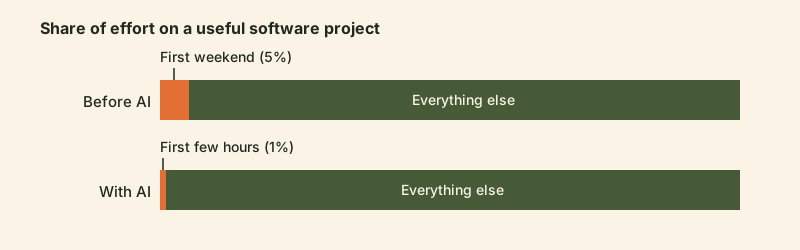
For small solutions, where the initial scaffolding is most of the work, AI has changed things. A one-off script, a landing page, or a simple internal tool can go from idea to first version in a fraction of the time it used to take.
But for anything bigger than that, the total effort is still on the same level. The first version comes together amazingly quick, because it's mostly typing and boilerplate. Everything after that comes together faster, but not fast.
Picture the effort on a project over time:
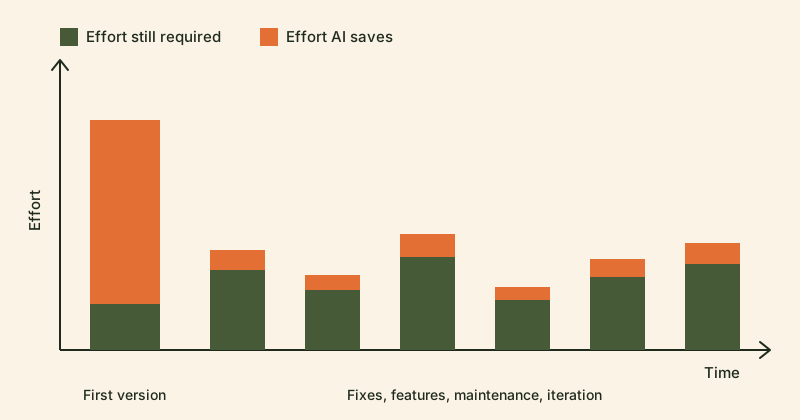
The first bar, building the initial version, gets most of its effort removed. Every iteration after that only gets a little faster. Add up the whole project and most of the effort is still there.
Building a product this year
I've spent this year working on Wealthsplitter with AI as my coworker. AI has saved me a ton of time on the parts it's good at.
It has also still taken an enormous number of hours.
I loosely log my project time, and this year Wealthsplitter has taken over 1,300 hours across 730 commits. Almost none of that was the initial build, since the app has been around since 2023. It was talking to users, reading the numbers, changing who the product is for more than once, and reworking the app every time I learned something new. That's the part of the chart where AI helped less, and it's where nearly all the time went.
Yet
This is probably not permanent.
Models and the tools around them are improving quickly, and some of those hard parts will get easier. But right now, the value of software comes from the same place it always has: understanding a problem well and sticking with it long enough to solve it for your customers.
AI makes the first step cheap. But you still need the other 10,000 steps.